BestInterest for Coparents
- 4.4
- Rating
- 10.00K
- Installs
- Free
- Price

 Analysis by App-foxy
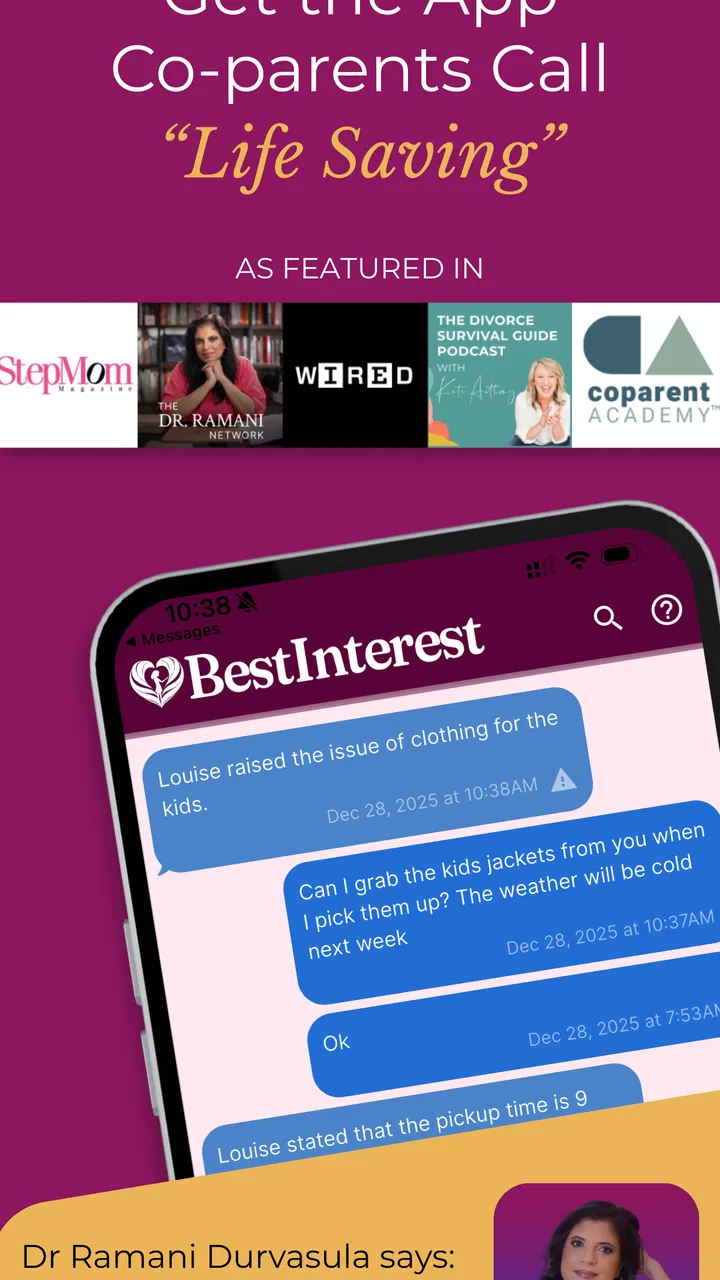
Co-parenting is rarely difficult because parents lack calendars or messaging apps. The harder problem is keeping everyday decisions clear when emotions are still close to the surface. BestInterest for Coparents is built for that particular situation: it is a parenting app from BestInterest that uses AI as part of an effort to make communication calmer, more organized, and suitable for situations where records may matter later. I approached it less like a general family planner and more like a communication tool for separated parents who need a steadier way to handle practical responsibilities.
My first impression is that its purpose is unusually focused. It is not trying to be a broad social network, a child-entertainment app, or a replacement for legal advice. The central appeal is the possibility of turning tense co-parenting exchanges into clearer, more measured conversations. That can be useful when the topic is a schedule change, a school message, a medical appointment, a forgotten item, or a disagreement about what was previously decided.
The real value is not simply sending another message. It is creating a more deliberate space between an emotional reaction and the response that eventually reaches the other parent. That distinction matters, although it also means the app works best when both people are willing to use a shared process rather than treating it as a weapon in an existing dispute.
You May Also Like

 Blood Strike: 2.5 Anniversary
Blood Strike’s Loadouts Turn Every Drop Into a Tactical Gamble
A close look at Blood Strike’s custom loadouts: how fast access to signature weapons reshapes its battle royale rhythm, rewards preparation, and narrows the gap between fights.

 Pandora - Music & Podcasts
Pandora’s Music Is Easy to Start, but Harder to Recover
Pandora’s strength is its low-effort path from a seed to a station. Its weak spot is how much confidence it asks you to place in connection, setup, and quiet recovery.

 8 Ball Pool
 Is Built on Rivalries, Rematches, and Routine
A close look at the rivalries, rematches, shared routines, and unanswered safety questions that turn a quick pool match into a persistent mobile community.

 Samsung Music
’s Quiet Strength Is Playing What You Already Own
Its reach comes less from spectacle than from dependable access to a personal library. That simplicity is both the app’s strongest retention engine and its ceiling.

 AccuWeather: Weather Radar
AccuWeather Review: A Quick, Clear Forecast for Everyday Decisions
For everyday plans, the best forecast is the one you can understand quickly. AccuWeather makes rain timing, radar, and local conditions easy to act on, with a few trade-offs.

 Hill Climb Racing
Why Hill Climb Racing Still Turns Crashes Into One More Run
A tiny car, a bumpy hill and one more upgrade: Hill Climb Racing keeps resurfacing because its simple chaos makes every near-miss feel personal.
More From Our News Desk



How BestInterest fits into everyday co-parenting
I find the most useful way to judge BestInterest is to try it with one recurring task, such as confirming a handoff or coordinating a school change, rather than moving every conversation at once. That gives both parents a manageable chance to see whether a calmer, more organized exchange actually saves effort. It also makes the next question clearer: how the app’s current version fits people who already have an established routine.
A focused tool rather than a general family organizer
BestInterest belongs in the parenting category, but its identity is narrower than a typical family calendar. A general organizer may be enough for parents who communicate comfortably and only need reminders. Here, the intended use is more sensitive: keeping communication calm and structured when cooperation takes effort.
That focus changes how I would use it. I would not open it merely to record every ordinary family detail. I would use it when a message needs careful wording, when a decision should be easy to revisit, or when the history of an exchange could become important. The app’s AI angle is most meaningful in those moments, because drafting a neutral message is often harder than knowing what information needs to be shared.
For example, imagine that a child has a school activity on a day that normally belongs to the other parent. A rushed text might sound accusatory even if the intention is only to coordinate transport. A more useful workflow is to state the event, explain the practical change, suggest a solution, and leave personal frustration out of the message. BestInterest is appealing because it is designed around that kind of disciplined exchange rather than casual conversation.
Where the calm-communication idea helps
In my view, the strongest use case is the recurring low-level friction that drains time: late pickups, missing information, changes to plans, and questions that are easy to misread. These issues are not always serious enough for professional intervention, but they can still create a pattern of conflict. A tool that encourages concise, factual communication may reduce the number of conversations that spiral.
There is also a practical benefit to separating the child’s needs from the parents’ history. When a conversation is written around dates, responsibilities, health information, school details, or logistics, it becomes easier to see what actually needs an answer. That does not solve disagreement by itself, but it can make the next step more obvious.
I would be especially careful with messages that contain several subjects at once. A useful habit is to handle one decision per exchange: first confirm the appointment, then discuss transport, then address any cost or schedule question. Even if the app does not remove the underlying disagreement, this workflow makes later review less confusing and gives both parents a fairer chance to respond to each point.
What the AI should and should not do for you
The AI positioning is attractive, but I would treat it as an editing aid rather than an authority. It may help a parent notice loaded language, shorten an emotional draft, or organize a response around facts. It should not decide what custody arrangement is legally correct, determine whether a parent is telling the truth, or replace a lawyer, mediator, therapist, doctor, or school professional.
This distinction is important because “court-admissible” language can easily be misunderstood. A calm message is not automatically accepted as evidence, and an app cannot guarantee how a court will view a record. The safer approach is to think of the app as helping you communicate and preserve a clearer account of practical exchanges. If a legal matter is active, I would follow professional advice about documentation and avoid assuming that the app alone satisfies any formal requirement.
My most useful tip would be to write the raw facts first and the emotion separately. Note what happened, when it happened, what response is needed, and by when. Then use the app’s communication approach to produce a message that does not include speculation or old grievances. This gives the AI a better starting point and keeps the parent responsible for checking every final word.
Cost, access, and the question of paid value
The app is free to install, which makes it reasonable to test before committing to a co-parenting system. Its content rating is Everyone, and it runs on Android devices using version 7.0 or later. The current version is 3.0.3, so compatibility is not limited to only recent phones.
There are in-app purchases ranging from $9.99 to $299.99 per item. That is a wide span, and it means “free” should be understood as free entry rather than proof that every useful part of the experience costs nothing. I would begin with the no-cost access, learn what is available in practice, and only then judge whether a paid option offers enough value for the specific communication problems in my family.
The price range also makes it difficult to recommend purchasing on impulse. A low-cost upgrade might be easy to justify if it saves repeated arguments or reduces time spent rewriting messages. A much larger purchase deserves a more careful comparison with ordinary alternatives, especially if only one parent is likely to use the service. The important question is not whether the app sounds valuable in theory, but whether it changes a recurring problem that is currently costing you time, stress, or professional fees.
I would not treat the paid options as a substitute for a parenting plan or legal support. Their value, if they fit your situation, comes from making day-to-day communication more manageable. Before paying, I would check which functions are included in the free experience and whether both parents can realistically participate. A co-parenting tool loses much of its practical advantage when only one side adopts the workflow.
How it compares with familiar alternatives
The most obvious alternative is ordinary text messaging. Texts are convenient, familiar, and almost guaranteed to be available, but they also encourage fast reactions and can scatter important information across unrelated conversations. BestInterest is more appealing when the goal is to slow down, organize, and keep a communication trail that is easier to understand.
Email is better for longer explanations and attachments, but it can become unwieldy when several decisions are mixed together. A shared calendar is excellent for visibility around dates, yet it does not necessarily help with the wording of disagreements or the context behind a change. A general notes app can store information, but it usually does not address the interpersonal problem that caused the note to be necessary.
Professional mediation is the stronger option when parents cannot reach basic agreements, feel unsafe communicating directly, or are dealing with serious legal conflict. BestInterest may support calmer exchanges around that process, but it cannot perform the human work of mediation. Likewise, parents who already communicate respectfully and only need a simple schedule may find a standard calendar less complicated and more economical.
Small workflows that make the app more useful
I would use a “draft, check, send” routine rather than composing messages while angry. First write the practical request. Next remove assumptions about motives, references to old arguments, and phrases that invite a defensive reply. Finally check that the message says exactly what action is needed and includes the relevant timing. This is a simple process, but a focused AI co-parenting app is better suited to it than a normal chat window.
A second useful approach is to create a short record after an agreement: what was decided, which child-related issue it covers, and what happens next. This avoids relying on memory when the same subject returns weeks later. The record should remain factual and restrained. Adding commentary about the other parent may feel satisfying in the moment but makes the information less useful to anyone reviewing it later.
A third trade-off is deciding when not to respond immediately. If a message is upsetting but does not require an urgent answer, I would prepare a draft and return to it after the emotional reaction has passed. The app can support a calmer process, but the parent still has to choose patience. No AI can make a hostile reply harmless if the user sends it without checking.
For shared responsibilities, I would also separate requests from complaints. “Please confirm pickup at the school gate by six” is easier to answer than a paragraph explaining why the other parent is always unreliable. This may sound obvious, but co-parenting tools earn their keep through repeated small improvements, not one dramatic feature.
Limitations I would take seriously
The biggest limitation is participation. If one parent refuses to use the app, ignores carefully written messages, or deliberately creates conflict, the platform cannot manufacture cooperation. It may still help the parent who uses it stay organized, but the shared benefit becomes smaller.
The second limitation is the risk of overtrusting AI. A polished message can still contain an incorrect date, an incomplete explanation, or a tone that feels artificial. I would review every suggestion personally, particularly when discussing medication, school obligations, expenses, travel, or a change that could affect a parenting agreement. Speed is less important than accuracy in these situations.
There is also a learning curve in changing habits. Parents accustomed to quick texts may find a more deliberate workflow slower at first. That friction is not necessarily a flaw; it may be part of the point. Still, if your situation involves only friendly coordination, the extra structure could feel unnecessary.
Finally, the broad range of paid purchases means the value calculation is personal. The free starting point lowers the risk of trying it, but I would not assume that paying more automatically produces better co-parenting. The right purchase is the one connected to a clear need, not the one with the most impressive promise.
Who is likely to benefit most
I think BestInterest is best suited to separated parents who are able to communicate but repeatedly get pulled into misunderstandings. It may also help someone who knows what needs to be said but struggles to phrase requests without sounding confrontational. Parents managing frequent schedule changes, school coordination, or recurring handoff details are the people most likely to notice a practical difference.
It is less suitable for parents who already have a simple, respectful routine and do not need help drafting or organizing communication. I would also hesitate to recommend relying on it alone where there is intimidation, harassment, immediate safety risk, or a major legal dispute. In those circumstances, professional guidance and appropriate safety planning should come first.
The app has a 4.4 average from around a hundred ratings, with more than a dozen written reviews, and it has passed ten thousand installs. Those figures suggest an established but still relatively small audience rather than a universally adopted family platform. I see that as a reason to test it carefully in your own circumstances, not as a reason to dismiss it.
My verdict on trying or skipping it
After looking at the app through the lens of real co-parenting, I would try BestInterest if my main problem were tone, repetition, or uncertainty about how to document everyday arrangements. The free access makes experimentation sensible, and the focused design is more relevant to conflict-prone communication than a normal messaging app.
I would skip it if I only needed a basic shared calendar, if both parents already coordinate smoothly, or if I expected AI to resolve fundamental disagreements. I would also avoid making a substantial purchase until I had tested whether the other parent would participate and whether the workflow actually improves conversations in practice.
My recommendation is therefore cautious but positive: start without paying, use it for one recurring issue, and judge the result by concrete changes. Are requests answered more clearly? Are fewer details lost? Do messages require less rewriting? If the answer is yes, the app may justify a paid option that matches your needs. If not, a simple calendar, email routine, or professional support may be the better choice.
BestInterest is most valuable as a communication discipline, not a magic solution. Used with careful fact-checking and realistic expectations, it can give co-parents a calmer way to handle the ordinary decisions that often become extraordinary sources of stress. That is a worthwhile promise, provided the people using it remain responsible for the decisions, the accuracy, and the care behind every message.
FAQs for BestInterest for Coparents
01What is BestInterest for Coparents, and who is it designed for?
BestInterest for Coparents is a co-parenting support app designed to help separated or divorced parents organize communication, schedules, responsibilities, and child-related information in one place. It may be useful for parents who want clearer coordination and fewer misunderstandings, especially when managing school events, appointments, custody arrangements, expenses, and everyday updates across two households.
02What features can parents use in BestInterest for Coparents?
The app is intended to support practical co-parenting tasks such as sharing calendars, coordinating parenting time, recording important child information, managing expenses, and keeping communication focused on the child’s needs. Depending on the current version and platform, available tools may vary. Before downloading, parents should review the app listing and privacy information to confirm which features are included on Android or iOS.
03Can BestInterest for Coparents replace a court-approved custody agreement?
No. BestInterest for Coparents should be treated as an organizational and communication tool, not as legal advice or a replacement for a parenting plan, custody order, or professional mediator. Parents should continue following any court-approved agreements and local laws. If a disagreement involves custody, safety, support payments, or legal rights, it is important to consult a qualified family-law professional rather than relying only on information stored in the app.
04Is BestInterest for Coparents suitable for high-conflict co-parenting situations?
The app may help high-conflict parents keep conversations and planning more structured, since written records, shared schedules, and child-focused information can reduce reliance on scattered messages. However, no app can resolve abusive, threatening, or severely contentious situations by itself. Users should consider professional guidance and prioritize safety. They should also check how the app handles message history, notifications, access permissions, and records before using it for sensitive matters.
05Is my family’s information private and secure in BestInterest for Coparents?
Before entering names, addresses, medical details, school information, financial records, or private messages, users should read BestInterest for Coparents’ privacy policy and app-store disclosures carefully. Look for details about encryption, data storage, account access, sharing with third parties, backups, deletion requests, and whether information is used for analytics or advertising. Security features and policies can change, so verify the latest details on the official download page.
Pros
- Keeps co-parenting messages and updates organized in one place.
- Shared calendars make custody schedules easier to follow.
- Useful reminders can help prevent missed parenting responsibilities.
- Designed to support clearer communication between separated parents.
- Can reduce confusion around appointments
- activities
- and handoffs.
Cons
- Both parents may need to use the app for its full benefits.
- Some features may require a paid subscription or in-app purchase.
- Setup can take time when entering detailed schedules and child information.
- It may not replace legal advice or formal custody documentation.
- Notifications may become overwhelming if too many updates are enabled.

BestInterest for Coparents
Gallery